


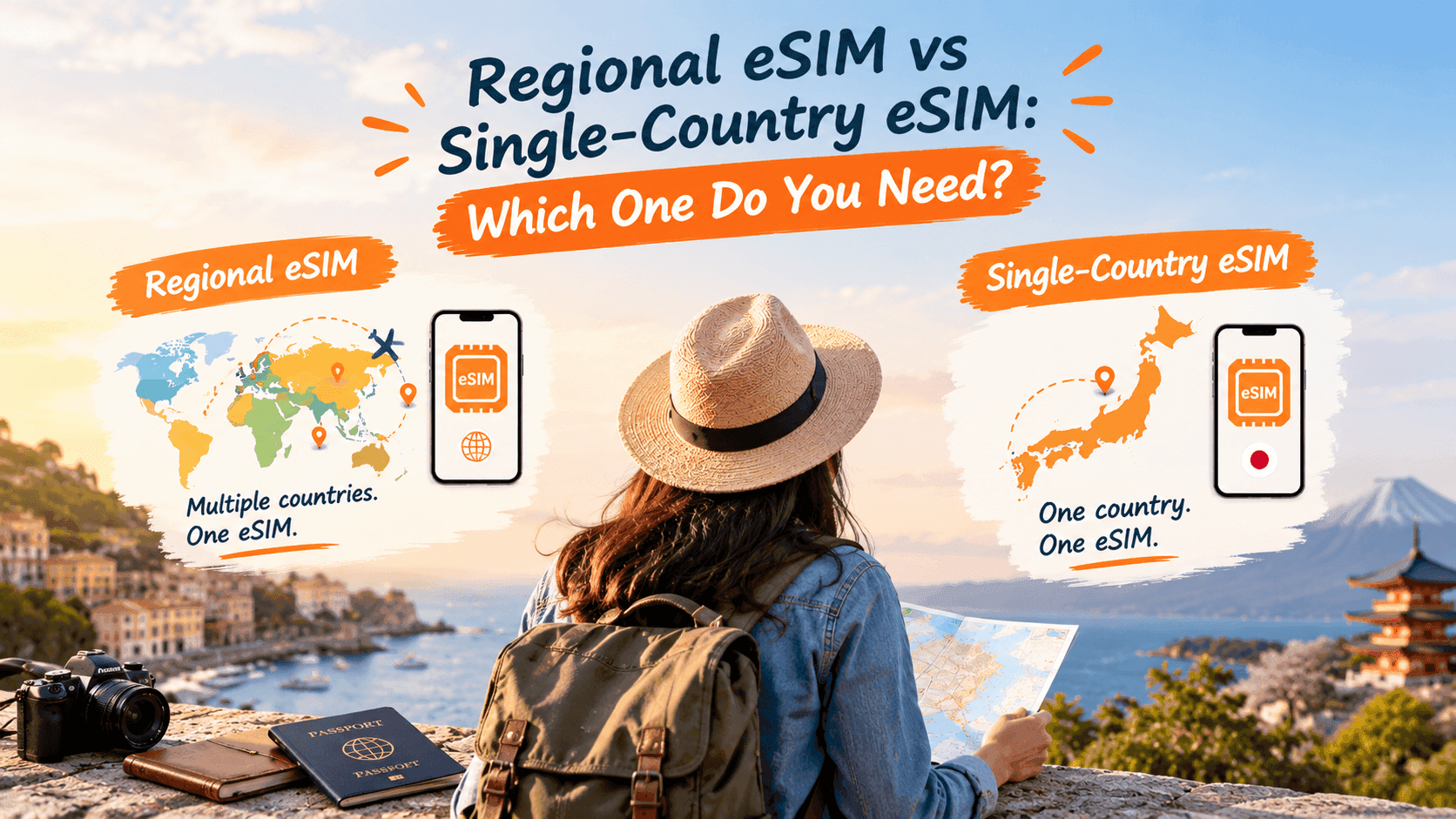
You are flying Mumbai to Paris, taking a train to Brussels and finishing in Amsterdam, and the plans page shows both a France eSIM and a Europe eSIM. Choosing wrong means either paying for coverage you never use or buying a second eSIM at a border. The right pick depends on how many countries you cross and how long you stay in each.
Short answer
A single-country eSIM covers one country. A regional eSIM covers a group of countries on one plan, such as the 33 countries in the Europe plan. One country for the whole trip: pick the single-country plan. Two or more countries: a regional plan is usually simpler.
What each type actually is
An eSIM is a SIM built into your phone, so there is no small plastic card to swap. People often call it an eSIM card or an e sim, but nothing physical arrives. You buy an eSIM online, scan a QR code and the plan sits on your phone.
A single-country eSIM works in one named country. A regional eSIM works across a list of countries under one data allowance. The same QR code, the same data balance, no new install at the border. Olysim sells regional plans for Europe (33 countries), Asia Lite, Asia Max, the Middle East, Africa, Latin America, North America and the whole world.
The differences that matter
| Question | Single-country eSIM | Regional eSIM |
|---|---|---|
| Countries covered | One | A listed group, for example 33 in Europe |
| Installs for a three-country trip | Three | One |
| Data allowance | Separate for each country | Shared across all of them |
| Best use | A long stay in one place | A route across borders |
One honest point against regional plans: if you spend two weeks in a single country, a regional plan gives you coverage you do not use. Check the plan page for data sizes and validity, as both differ from one plan to the next.
Which one suits which traveller
A family on a ten-day trip to one country
Pick the single-country plan. If you fly to Delhi to Dubai and stay there, the Middle East regional plan adds nothing. Several phones can use the data one after another, so size the plan to the busiest phone.
Someone alone on a train route through Europe
Pick the Europe plan. Paris, Brussels and Amsterdam on one QR code means no stopping at a station to buy eSIM data. If you later add Italy or Hungary to the route, they are already covered.
Someone working remotely for a month
Staying in one city, a single-country plan with a larger data size is the cleaner choice. If you plan to hop between countries on weekends, a regional plan saves you juggling installs.
Someone on a Singapore, Kuala Lumpur and Bangkok loop
The Singapore, Malaysia and Thailand plan was built for exactly that loop. One plan, three countries.
Someone flying across continents on one ticket
The Global plan covers countries across regions. It suits a Delhi, Doha, Toronto routing where a regional plan would stop at one leg.
Count the countries on your itinerary. One country means a single-country plan. Two or more usually means a regional plan, as long as every stop is on its list.
Checking a regional plan covers your stops
Regional plans cover a defined list of countries, and a neighbouring country may not be on it. Open the plan page and read the country list before you pay. The UK, for example, sits outside many Europe bundles, so confirm it if London is on your route.
Installing more than one plan
Phones can store several eSIMs, and you switch the active one in your mobile settings. Our guide on adding an eSIM without deleting the old one explains the limits. Check your handset on the eSIM compatible device list, then follow the installation guide. A physical travel SIM is also available for phones without eSIM support, and it works the same way on a regional plan.
The short version
Match the plan to the route. One country, one plan for that country. A route across borders, one regional plan that lists every stop. Compare the data size and validity on the page, and pick the smallest option that fits your days.


