


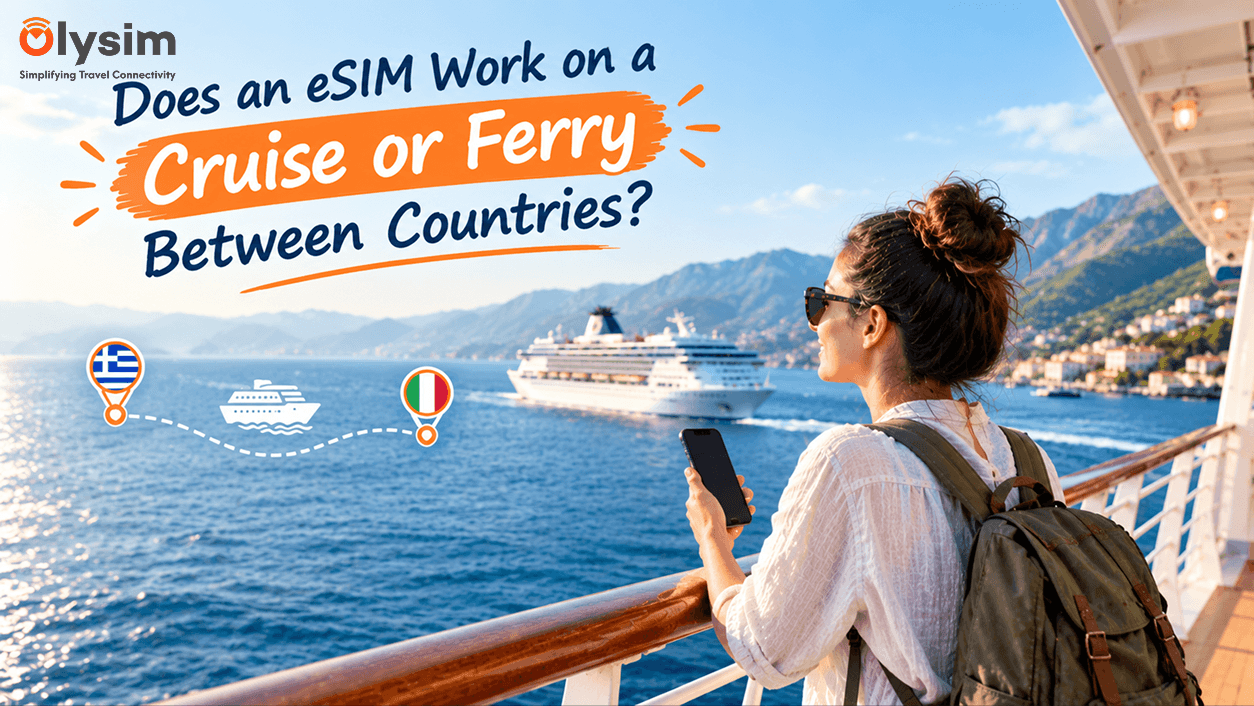
You have booked a week on the Mediterranean, or a ferry from Athens to Santorini, and people keep giving you different answers about phone signal at sea. Some say the phone is dead the moment the ship leaves port. Others say it works like normal. The truth sits in the middle, and it depends on where the ship is.
Short answer
A travel eSIM works in port and near the coast, where your phone can reach a land tower. Out in open water it usually has no signal. Short ferries stay in range for most of the crossing. On a cruise, expect data in port and on shore days, and ship wifi at sea.
An eSIM is a SIM built into your phone, so there is no small plastic card to swap. People call it an eSIM card or an e sim, but nothing physical arrives. You buy an eSIM online, scan a QR code and the plan sits on your phone. Here are the common beliefs about sea travel, one at a time.
"My eSIM will not work once the ship leaves port"
Partly true. Phone signal comes from towers on land. Coastal towers reach roughly 20 to 30 km offshore, depending on terrain and tower height. A ferry that hugs the coast, such as Athens to the Cyclades or Split to Hvar, stays in range for much of the trip. Signal drops in the middle of longer crossings.
So the belief is right for open sea and wrong for coastal routes. If your ferry shows land on both sides, your phone will usually have data.
"The ship's own network means I do not need an eSIM"
Not quite. Large cruise ships run their own mobile network at sea, and some phones connect to it automatically. Connecting this way can be billed at maritime rates, which are far higher than a normal data plan. Switch on airplane mode as you leave port, then turn wifi on if you want the ship's wifi package. Check with the cruise line for the price before you buy it.
The eSIM is for the ports, where you are on land and a local network does the work. Ship wifi is for sea days. They do different jobs.
Do
Turn on airplane mode before the ship sails, then switch on wifi only if you have bought ship wifi.
Do not
Leave mobile data on at sea. Your phone may join the ship's network and bill at maritime rates.
"One eSIM covers every port on my route"
True only when the plan lists every country on the itinerary. A Mediterranean cruise from Barcelona might touch Spain, France, Italy and Greece in eight days. The Europe plan covering 33 countries fits that route with one install. For a Gulf cruise out of Dubai, look at the Middle East plan. The full explanation of how these differ is in our guide to regional and single-country plans.
Read the country list on the plan page against your itinerary before you pay. A port in a country outside the list will have no data from that plan.
"It is better to buy the eSIM once I board"
False. Ship wifi is slow and priced by the day, and buying and installing an eSIM on it can fail halfway. Install at home, the night before you fly, using the installation guide. Check your handset on the eSIM compatible device list at the same time. Then the plan is waiting when you reach the first port.
What each kind of trip looks like
| Trip | When the eSIM connects | What to plan |
|---|---|---|
| Short coastal ferry, 1 to 2 hours | Most of the crossing | Nothing extra |
| Overnight ferry across open water | Near both ports only | Download maps and tickets before sailing |
| Week-long cruise | In port and on shore excursions | A regional plan that lists every port country |
| River cruise | Most of the trip, as the river runs through towns | Plan covering each country on the river |
"Cruise ports have signal like any city"
Mostly true. Ports in Barcelona, Civitavecchia near Rome or Piraeus sit beside large cities with strong coverage. Smaller stops such as an island tender port can be patchy. Ship's tenders often drop you at a pier with good signal, then it thins on hill walks.
Save your return time and the ship's gangway deadline as a screenshot. Ships do not wait, and a map or note that works without signal beats one that needs it. For data needs on shore days, a few hundred MB covers maps and messages. The longer figures are in our guide on how much data you need for a week abroad.
Treat the eSIM as your connection on land and the ship's wifi as your connection at sea. Keep mobile data off between ports.
If your phone only takes a physical SIM
A physical travel SIM is available for phones that do not support eSIM. It follows the same rules at sea, so keep mobile data off between ports. Swapping a SIM on a moving ship with a tiny tray is fiddly, so fit it at home before you leave.
The short version
Install a plan that lists every port country, keep mobile data off at sea, and download tickets and maps before sailing. Your phone will do the rest in port.


