


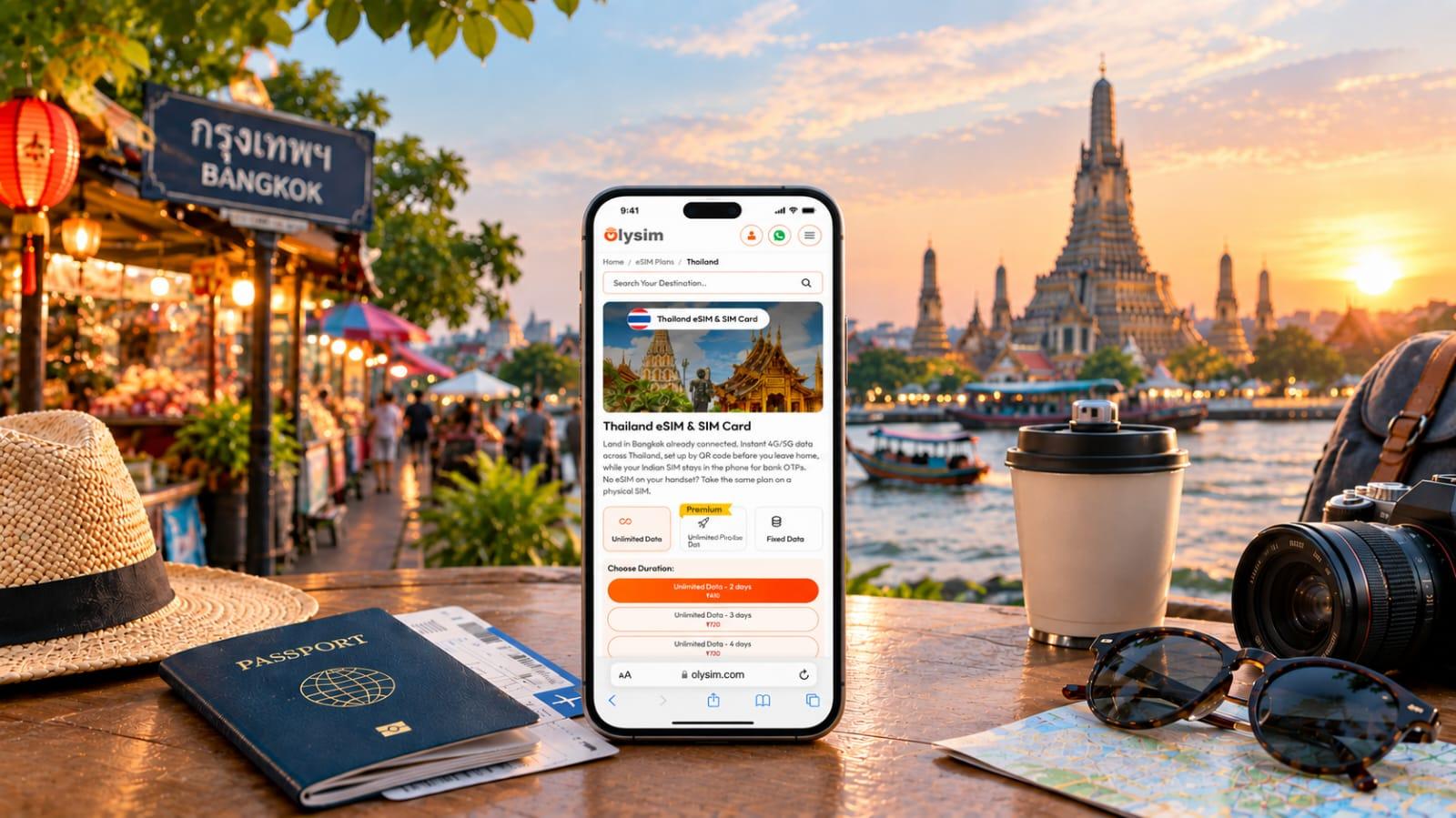
You land at Suvarnabhumi or Don Mueang after a flight from Delhi or Mumbai, and the first decision waiting for you is whether to join the queue at the AIS or dtac counter, or open your phone and switch on an eSIM you already installed. The honest answer depends on more than just the sticker price.
Quick answer: a local Bangkok SIM and a travel eSIM often cost a similar amount for the data itself, but an eSIM installed before you fly saves you the airport queue, the cash payment at the counter, and gets you connected the moment you land, not after.
What buying a local SIM in Bangkok actually involves
Suvarnabhumi and Don Mueang airports have AIS, dtac and True counters in the arrivals area, usually visible right after immigration. You will need your passport to buy a tourist SIM card on the spot, and the process is generally straightforward.
Even so, the counters see heavy footfall since Thailand is one of the most visited countries from India, so queues can build up quickly when several flights land close together. You also need to physically remove your Indian SIM and store it somewhere safe, then remember to put it back before you fly home.
What installing an eSIM before you fly involves
An eSIM is a SIM built into your phone, so there is no small plastic card to buy or swap. You install it at home using a QR code, ideally the night before your flight while you still have wifi or your Jio, Airtel or Vi data.
By the time you land in Bangkok, your eSIM is already sitting on your phone, ready to turn on. There is no counter to find, no passport to hand over for a SIM, and no need to touch your Indian SIM at all, since it stays in your phone the whole time.
Bangkok airport SIM counter vs eSIM before you fly
| Question | Local SIM at Bangkok airport | Travel eSIM before you fly |
|---|---|---|
| When you can set it up | Only after landing, at the counter | Before you fly, from home |
| Do you need your passport at the counter | Yes | No |
| Do you remove your Indian SIM | Yes, and you need to store it safely | No, it stays in your phone throughout |
| Can your Indian number still get OTPs | Only once you put your Indian SIM back | Yes, throughout the trip |
| Time to get connected after landing | Fifteen to thirty minutes, depending on the queue | Almost instant, once you turn off airplane mode |
Does an eSIM actually save you money over a Bangkok SIM?
The data itself is often priced similarly between a local Bangkok SIM and a travel eSIM, so the sticker price is not always where the real saving is. Where you do save is by skipping an Airtel, Jio or Vi international roaming pack entirely, which usually costs far more for the same amount of data.
If your trip continues beyond Bangkok to Phuket, Chiang Mai or elsewhere in Thailand, an eSIM plan already covers the whole country, so there is no need to buy a fresh SIM again mid-trip.
Keeping your Indian number live for OTPs in Thailand
Most phones that support eSIM can also keep your regular Jio, Airtel or Vi SIM active at the same time, in what is called dual SIM mode. This means your Indian number can still receive GPay and PhonePe OTPs while your eSIM handles data in Thailand, something a physical Bangkok SIM cannot do since it takes over your SIM slot entirely.
Read our full breakdown in receiving OTPs while using a travel eSIM abroad if this matters for your trip.
Setting up your Bangkok eSIM before you fly out of India
Check your phone supports eSIM on the eSIM compatible device list, then install your Thailand eSIM at home using our eSIM installation guide. Set it as your data line, keep your Indian SIM active for calls and SMS, and you are ready before you even board.
If your route also covers Singapore or Malaysia, a Singapore, Malaysia and Thailand eSIM plan covers all three under one profile. Browse Thailand eSIM plans starting from a low daily cost on Olysim's plans page before you fly.


