


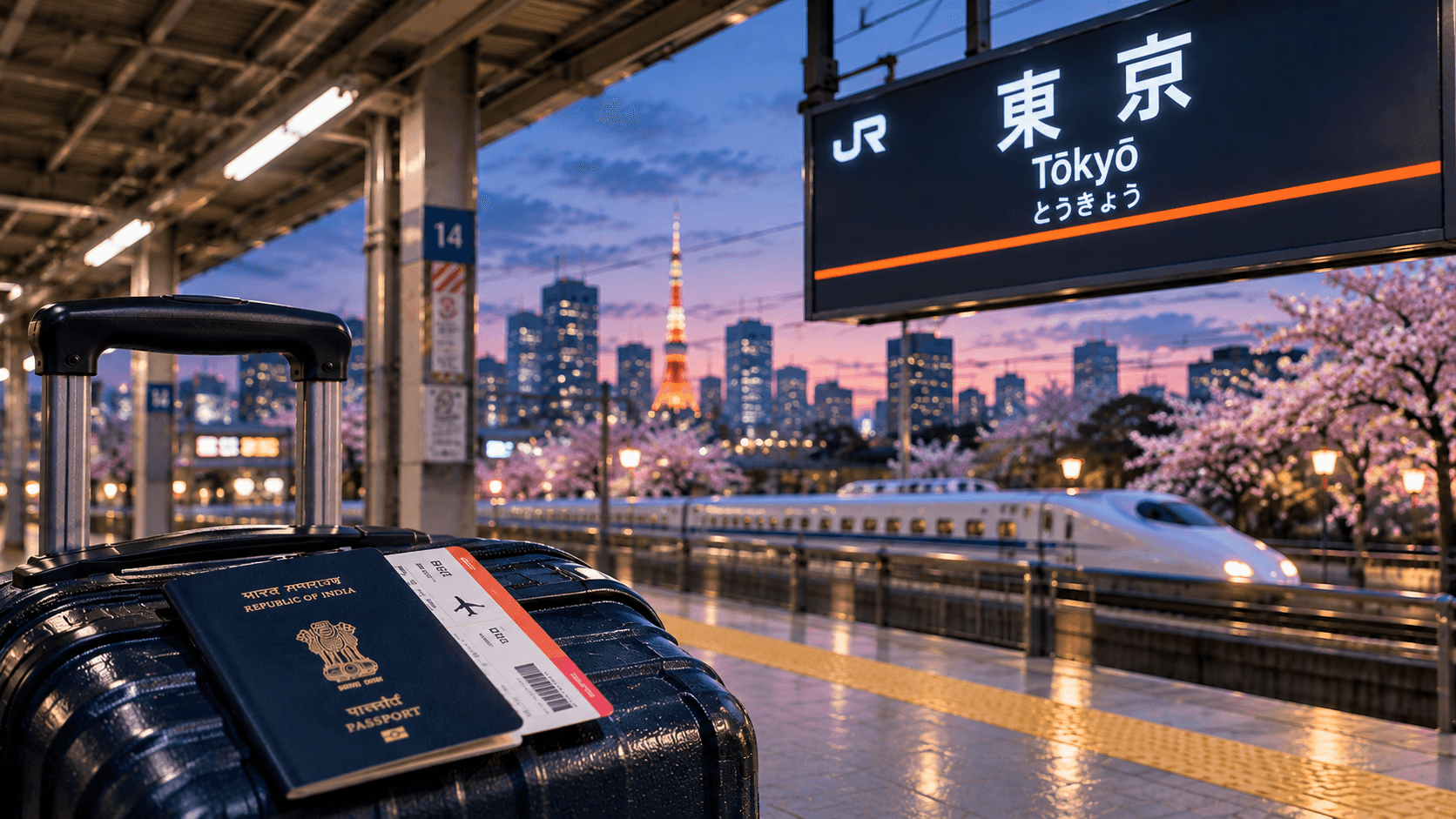
You land at Narita or Kansai airport after a long flight from Delhi or Mumbai, and Japan's train and metro apps, restaurant queue systems and Google Maps all need data to work. Getting online quickly in Japan matters more than in most countries, since so much daily life there runs through apps.
Quick answer: the easiest way for Indian travellers to get mobile data in Japan is a travel eSIM installed before you fly, so it is ready the moment you land. This skips the airport SIM or pocket wifi counter, and lets you keep your Indian SIM active for bank OTPs.
Your SIM options for a Japan trip
Travellers to Japan usually choose between three options: a physical tourist SIM bought at the airport, a rented pocket wifi device, or an eSIM, a SIM built into your phone, installed before you fly. Each works, but they are not equally convenient.
A physical SIM means queueing at a counter in Narita, Haneda or Kansai airport, and Japan's SIM counters can be less crowded than other countries, but you still need to swap out your Indian SIM. A pocket wifi device needs charging, carrying separately, and returning before you fly home, usually at a post box or the airport counter again.
Why an eSIM works well specifically for Japan
Japan's public transport, restaurant reservation systems and even some vending machines expect you to be online from the moment you land. An eSIM installed before you fly means you already have signal as you walk through arrivals, ready to pull up your train route on Google Maps or check into your hotel using an app.
You also skip carrying an extra device, which matters in Japan where you are often moving fast between trains with limited time to fumble with a pocket wifi battery. Set up is done through our eSIM installation guide, and takes a few minutes at home.
SIM, pocket wifi or eSIM: what actually suits your trip
| Question | Physical SIM | Pocket wifi | Travel eSIM |
|---|---|---|---|
| Set up before flying | No | Partly, but you collect it on arrival | Yes, fully |
| Extra device to carry and charge | No | Yes | No |
| Keeps Indian number active for OTPs | No, unless you have a second SIM slot | Yes, your phone's SIM stays in place | Yes, on most eSIM-supported phones |
| Return needed before flying home | No | Yes | No |
Keeping your Indian number active for OTPs in Japan
Most phones that support eSIM can run your regular Jio, Airtel or Vi SIM alongside the eSIM at the same time, called dual SIM mode. This means your Indian number keeps receiving GPay and PhonePe OTPs while your eSIM handles data in Japan.
This setup is covered in more detail in our guide on receiving OTPs while using a travel eSIM abroad, including what to check with your operator before you fly.
Does eSIM coverage work well across all of Japan?
Coverage in Tokyo, Osaka, Kyoto and other major cities is strong and reliable, including inside most train stations and on the shinkansen bullet train. In more remote areas, such as parts of rural Hokkaido or mountain trails near Mount Fuji, signal can be weaker, which applies to any SIM type, not just eSIMs.
If your itinerary includes quieter regions, download offline Google Maps for those areas before you leave city coverage.
Setting up your Japan eSIM before your flight out of India
Check your phone is eSIM compatible on the eSIM compatible device list, then install your Japan eSIM the night before your flight, while you still have wifi or Indian data. Set it as your line for data once you land, keeping your Indian SIM active for calls and SMS.
If you are still planning your trip budget, our guide on Japan trip cost from India covers overall spending beyond just connectivity.
A Japan eSIM installed before you fly means no airport counter, no pocket wifi to carry, and your Indian number still working for OTPs. Browse Japan eSIM plans starting from a low daily cost on Japan eSIM.


