


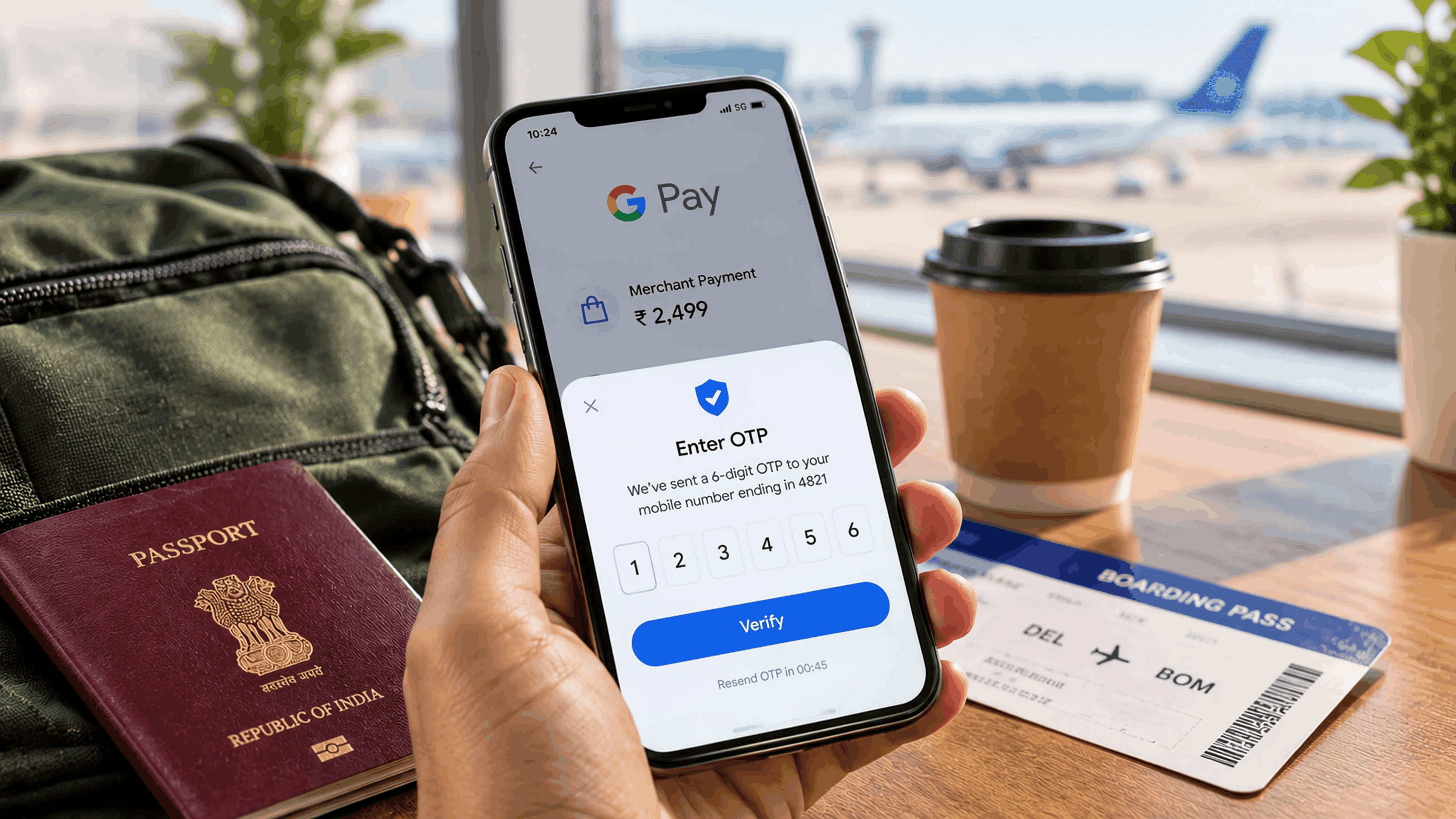
You are about to fly out of Delhi or Mumbai, and a worry hits you: what if you need to pay rent or approve a UPI transfer while you are abroad, and the OTP never reaches you? This is one of the most common questions we get from Indian travellers switching to a travel eSIM, and the short answer is reassuring.
Quick answer: yes, GPay and PhonePe OTPs will still reach you abroad, as long as your Indian SIM stays inside your phone and switched on for calls and SMS. A travel eSIM only replaces the SIM you use for data, so your Indian number keeps receiving messages exactly as before.
How a travel eSIM works alongside your Indian SIM
An eSIM is a SIM built into your phone, so there is no small plastic card to insert or swap. Almost every phone that supports eSIM can run it at the same time as your regular physical SIM, using what is called dual SIM mode.
This means you do not remove your Jio, Airtel or Vi SIM before your trip. It stays exactly where it is. You simply add the travel eSIM as a second line and set it to handle your mobile data abroad, while your Indian SIM continues to receive calls and SMS on your usual number.
Why this matters for GPay, PhonePe and bank OTPs
GPay and PhonePe send OTPs as an SMS to the mobile number linked to your bank account. Most Indian banks also send their own SMS OTPs directly for card payments and net banking. None of this depends on which SIM your data is running on.
As long as your Indian SIM is physically in your phone and not switched off, it will keep receiving these SMS messages anywhere in the world, the same way it does at home. The only real risk is if you deactivate or remove your Indian SIM entirely before flying, which some travellers do by mistake to save on international roaming charges.
Does keeping your Indian SIM on abroad cost you anything?
This is where it gets useful. You do not need an expensive Airtel, Jio or Vi international roaming pack just to receive OTPs. Most Indian telecom operators charge for incoming calls and SMS abroad only under specific roaming plans, and rates vary a lot by country.
Check with your operator before you fly, since some networks block incoming SMS entirely abroad unless international roaming is switched on for that number. If your operator requires roaming to be active even just for SMS, it is usually far cheaper to activate the most basic roaming option for SMS only, and let your travel eSIM handle all your actual data use.
Indian SIM plus travel eSIM vs full international roaming pack
| Question | Full roaming pack (Airtel/Jio/Vi) | Indian SIM (SMS only) + travel eSIM |
|---|---|---|
| Do OTPs reach your Indian number | Yes | Yes |
| Data speed and reliability abroad | Depends on the local partner network your operator ties up with | Runs on a local network in that country, chosen for coverage there |
| Can you top up data mid-trip easily | Usually needs another roaming pack purchase | Yes, from the eSIM plans page in a few taps |
| What you are paying for | Calls, SMS and data bundled together | Only the data you actually need, plus a small or no cost to keep SMS on |
Setting your phone up correctly before you fly
Getting this right takes a few minutes at home, ideally a day or two before you leave from IGI Airport, Mumbai or wherever you are flying out of.
- Buy your travel eSIM and install it while you still have wifi or Indian data.
- In your phone's mobile settings, set the travel eSIM as the line used for data.
- Keep your Indian SIM set to receive calls and texts, so GPay and PhonePe OTPs still land on it.
- Check with your Indian operator whether incoming SMS abroad needs roaming switched on for your number.
- Turn off data roaming on your Indian SIM specifically, so it is never accidentally used and billed.
You can check whether your exact phone model supports running two SIMs together on the eSIM compatible device list, and follow the full setup process on our eSIM installation guide.
What if your phone does not support eSIM?
If your phone is older and does not have eSIM support, you can still keep this same setup using a physical travel SIM instead, in your phone's second SIM slot, if it has one. Your Indian SIM stays in the first slot for OTPs, exactly as described above.
If your phone only has one SIM slot, you will need to choose between keeping your Indian SIM in and relying on wifi for data, or swapping SIMs when you specifically need an OTP. This is one of the few cases where an eSIM genuinely saves a Vietnam, Thailand or Europe trip from constant fiddling with tiny SIM trays.
Keeping your Indian number reachable for OTPs does not mean paying for a full international roaming pack. Set up your travel eSIM for data before you fly, and browse plans by destination on Olysim's plans page.


